Ekta Parishad
JAN SATYAGRAHA: A March for justice, the right to food, land, water, seeds, forests
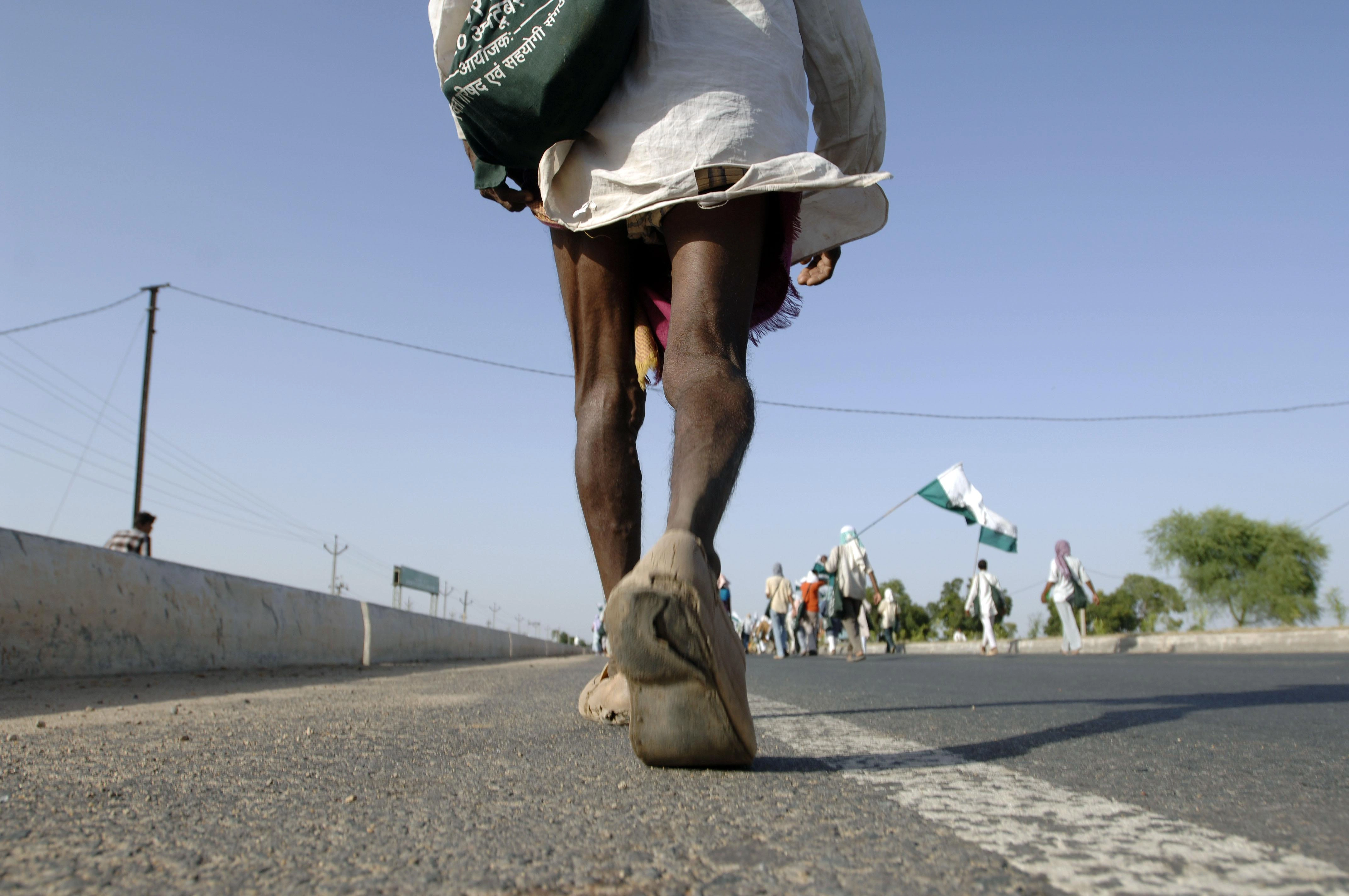
Organized in India from October 2011 to October 2012 by the Ekta Parishad movement, the non-violent march for justice Jan Satyagraha was a powerful and emblematic action. In its final stage in October 2012, it brought together 45,000 poor people, landless peasants, tribal peoples and Untouchables who marched for 15 days to assert their rights to vital resources and a life of dignity.
This march was a historic opportunity to highlight fundamental issues of social and economic justice: the sharing of wealth, access to natural resources, food sovereignty, the debts of poor countries, the place of the most destitute in our societies, the role of women, but also participatory democracy, the responsibilities of multinational corporations and the international financial system, and the choice of a sustainable and equitable model of life and development for all. It is not about assisting populations living in destitution, but about recognizing their rights to the resources essential to life, enabling their work and fostering their initiative.
Let us globalize solidarity
We invite citizens and civil society organizations to learn about this march in every possible way, and to demand, in a determined and peaceful manner, from international bodies (UN, FAO, WTO, European Union, OECD, G20, World Bank, etc.), the right of local populations to access natural resources (land, water, seeds, forests, etc.), which implies respecting existing legislation and strengthening it through regulatory and oversight mechanisms. Likewise, under international law, the right to food sovereignty must be recognized as superior to trade and investment rights.
On every continent, it is important to globalize solidarity. In 2012, we called on citizens to organize simultaneous and coordinated non-violent actions (marches, sit-ins, human chains, moments of silence, concerts, etc.) in connection with the Indian march for justice, particularly between October 2 (International Day of Non-Violence) and October 17 (International Day for the Eradication of Poverty).
The scale of the problem of the landless is fairly recent. These are people who are imprisoned, harassed, scorned, sometimes even killed simply because they are in the way.
Just fifty years ago, they still lived on their lands, inherited from their ancestors, most of them being tribal peoples, whether Native American, African or Indian. They harvested what they needed, day by day, without seizing the land on which they said they depended and which they called, with immense respect, Mother Earth.
With our heavy boots, we, the Westerners, arrived with our dominating, aggressive and moneyed civilization.
At the end of colonization, states, and India in particular, decreed that the land belonged to them, which seems logical since the whole country belongs to everyone. In India, however, those who had property deeds were able to assert their rights immediately.
The others, mostly illiterate and unaware of the very idea of property, claimed nothing, and everything went back to normal, since the State showed no intention of seizing the land.
In the 1980s and 1990s, the State began requisitioning land for major industrialization projects that it itself carried out, and very soon it also had to meet energy needs (dams), tourism development (national parks for tigers and elephants), infrastructure (highways, airports), and then came the massive invasion of multinational corporations hungry for land, water, space, forests and minerals to process.
Thus conflicts multiplied between those who lived on their ancestral lands (but without property deeds) and the State or the companies that benefited from these resources.
Subject for the most part to the fatalism of Karma, the poor (Adivasis, Untouchables, etc.) by the millions hunkered down and accepted these inhumane conditions, gathering in slums in the enormous cities to beg, wander and survive. Others, however, took the path of clandestine resistance, driven by violent, armed movements, very quickly co-opted by local mafias, among them the Naxalites (without passing any judgment on them).
More than twenty years ago, men like Rajagopal, defying traditional codes and customs, told them that karma was a convenient excuse and that if they lived an undignified life, it was because of the greed of men, the injustice of a system based on greed, domination and fear.
It took a long time, because a society does not change quickly; however, it was the children of those first reached by Rajagopal who took up the challenge. After multiple attempts since the 2000s, a great march was decided from Gwalior to Delhi over 300 km with 25,000 landless people, all of them - children, women, young and old - trained in non-violent action. And during this month of marching in October 2007, they demanded their right to a dignified life and respect for themselves and those they represented. Standing, marching, without contempt and without hatred but in a determined manner, they obtained full reward for their actions as early as January 2008.
Indeed, Congress and all the parliamentarians accepted the plan to reform rural law put forward by Ekta Parishad (the "United Forum" union), which represents a triumph of non-violent action.
But nothing is simple in India; the laws abolishing castes date back to 1947, and nothing has really changed, especially in rural areas where Hindu culture is present everywhere. The new laws on rural rights are not being enforced and are not ready to be. It was therefore decided immediately to launch another march, culminating in October 2012. Rajagopal and the 12,000 people he trained traveled from village to village throughout the country to mobilize those unjustly treated in their poverty, and then 45,000 of them marched on Delhi in October 2012. We also proposed to Rajagopal that this march be globalized across the five continents, and a number of movements answered the call, notably in Latin America.
In France, a 28-day march was organized from Le Croisic to the Trocadéro. September 21, World Peace Day, October 2 in Angers, World Day of Non-Violence, and in Paris at the Trocadéro on October 17, World Day for the Refusal of Poverty.
All women and men of good will are invited to take part, however small, in these events.
Documentaries about these events are available on the page dedicated to the Shanti association.
More than one billion people suffer from hunger
In this 21st century, more than one billion human beings suffer from hunger. Every 4 seconds, a person dies from the consequences of malnutrition, the majority of them children under the age of 5. 25% of the world's population consumes 85% of the available wealth, and every year 30% more resources than the planet can regenerate are used.
Half of the inhabitants of our world are farmers, three-quarters of whom still work exclusively by hand. Ensuring that these peasants have the conditions needed to live from their work is one of the major challenges of sustainable development, so that violence is not the only alternative for millions of poor, hungry, dispossessed people, subject to forced labor and displaced to the slums of large cities.
Land, water, seeds, forests, and minerals - common goods of humanity - are being seized by investors with the consent of states, or due to their powerlessness to prevent it. All over the planet, mining or forestry operations, large dams, tourist zones, hyper-intensive GMO-based export monocultures or agrofuel production are replacing food crops. This land grabbing is intensifying.
At the same time, the influx into markets in Southern countries of food produced in wealthy countries with enormous mechanical means and massive subsidies generates unfair competition that is ruining local farming communities.
Organizations that signed the declaration of support for the Jansatyagraha march:
http://www.mujerpalabra.net/activismo/mdnmadrid/pages/articles/art_sodepaz_marzo_2003.htm